Over the past five years, New Zealand has made steady progress in lifting business investment in research and development. More companies are investing, and total spend has trended upward. It’s an encouraging shift for an economy looking to build strength through innovation.
But the latest data from Stats NZ suggests that momentum may be starting to plateau. While total R&D spend has increased from 2024 to 2025, investment as a share of GDP has dipped slightly from 0.98% to 0.95%.
It’s a small movement, but a meaningful one. For a country still trying to close the gap with leading innovation economies, it signals that more work is needed to lift R&D investment.
A Reality Check: How NZ Compares Globally
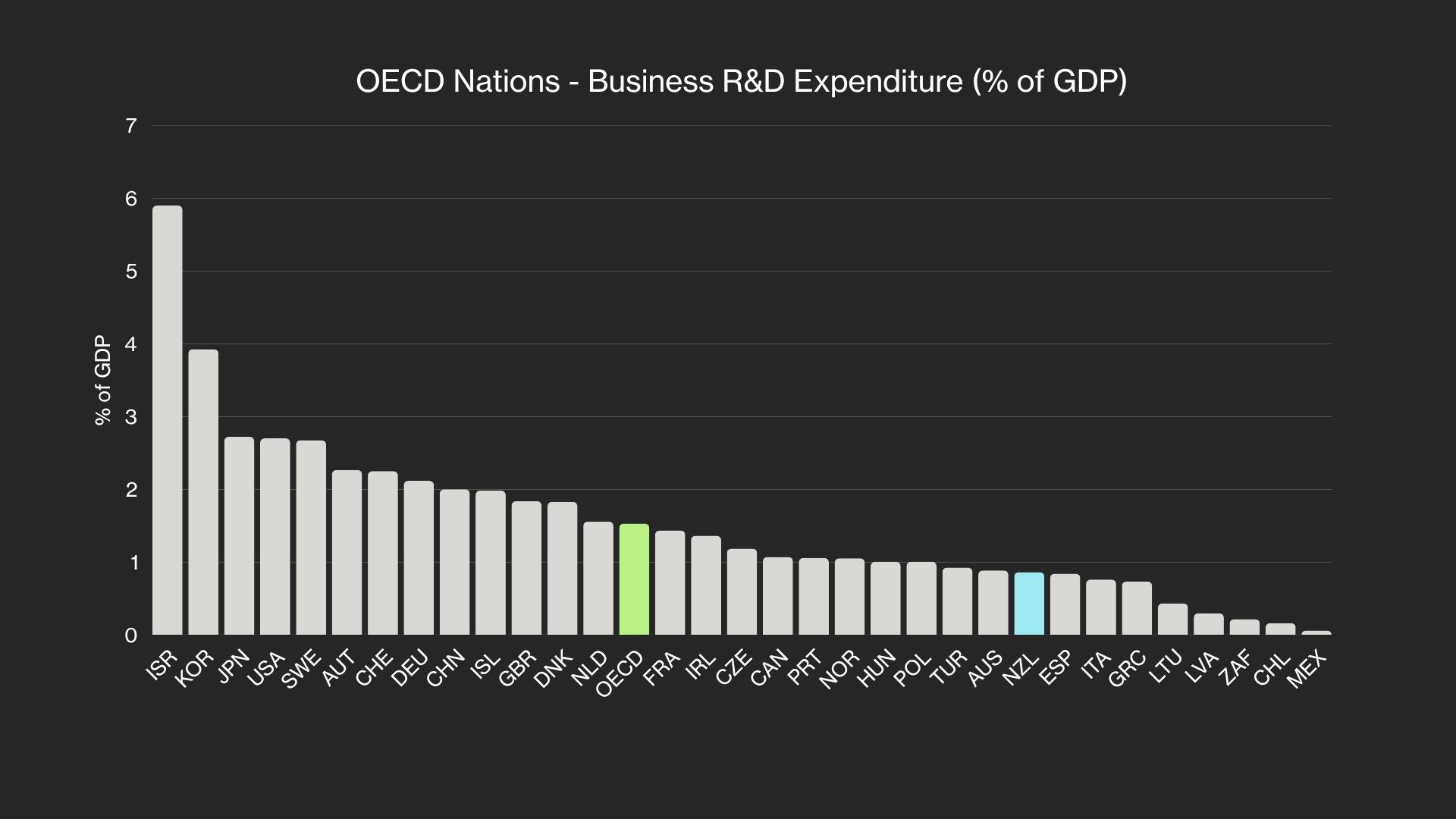
On the global stage, New Zealand still has ground to make up.
At 0.95% of GDP, our level of business R&D investment sits well below the OECD average of 1.53%. Leading innovation economies are operating at a completely different scale. South Korea sits at 3.93%, Japan at 2.72%, the United States at 2.7%, and Sweden at 2.6%.
Even when compared to similar economies, the gap remains. Ireland, with a comparable population, invests around 1.36% of GDP into business R&D.
The direction of travel in New Zealand is positive. But the pace is not yet enough to close the gap.
Why This Gap Matters
For larger economies, underinvestment in R&D is a missed opportunity. For New Zealand, it is a structural risk.
As a small, geographically isolated country, we do not compete on scale. We compete on ingenuity. Our ability to develop new technologies, create high-value products, and export innovation is what drives long-term growth.
That requires sustained investment in R&D.
Without it, we risk slower productivity growth, fewer globally competitive businesses, and limited movement up the value chain. In that context, business R&D is not optional. It is foundational.
A Lever That’s Working: The R&D Tax Incentive
One of the clearest tools New Zealand has to lift business R&D investment is already in place. The R&D Tax Incentive (RDTI).
While New Zealand has had various forms of R&D support mechanisms over the past two decades, the current version of the RDTI is still relatively new. Compared to many OECD countries that have operated mature R&D incentive regimes for decades, New Zealand is still in the early stages of building awareness, participation, and long-term behavioural change around the scheme.
Now five years in, the evidence is starting to emerge.
The recent review shows that for every dollar of tax incentive received, businesses are spending approximately $1.40 on R&D. That is a strong signal that the policy is encouraging additional investment, not just subsidising existing activity.
The mechanism is working.
The Real Constraint: Participation
If the mechanism is working, the next question is why we are not seeing faster growth.
A large part of the answer is participation.
Many businesses undertaking eligible R&D are still not claiming the incentive or are under-claiming what they are entitled to. In most cases, this is not due to a lack of activity. It comes down to perception.
Common barriers include:
- “We don’t do R&D”
- Uncertainty around eligibility
- Assumptions that the process is too complex or time-consuming
These perceptions are limiting the number of businesses accessing the RDTI. As a result, less capital is being reinvested into R&D, and fewer businesses are benefiting from the compounding effect the incentive is designed to create.
Making RDTI Work in Practice
This is where Swell plays a role.
Swell exists to help more New Zealand businesses access the R&D Tax Incentive and unlock funding they are already eligible for. The focus is simple. Increase participation and make the system easier to navigate.
That starts with helping businesses clearly identify what qualifies as R&D. For many, this is the biggest hurdle. From there, Swell manages the claim process end-to-end, reducing complexity and administrative burden.
The goal is to allow businesses to stay focused on running and growing their operations, while continuing to invest in innovation.
What This Looks Like in Action
Swell works with businesses across New Zealand, supporting them through the RDTI claim process.
Here are a couple of recent examples:
Nilo, an Auckland-based cleantech company developing technology to convert plastic waste into sustainable industrial adhesives, had not previously claimed the RDTI. Working with Swell, the business identified eligible R&D activity, structured its claims, and secured more than $2 million in R&D tax credits across two claim cycles. That funding has been reinvested back into continued technology development and commercialisation efforts.
👉 Read the full case study
Marque Magnetics initially assumed that much of their work, particularly customer-driven projects, would not qualify. In practice, a substantial portion of that work met the criteria for eligible R&D, unlocking funding they had not expected.
These examples reflect a broader pattern. Businesses are often closer to eligibility than they think, but without the right support, that opportunity goes unrealised.
From Progress to Acceleration
New Zealand has made real progress in lifting business R&D investment. The past five years show that change is possible, and that businesses are increasingly recognising the role innovation plays in growth.
But the latest data is a reminder that progress can stall.
We already have a mechanism that drives investment. The opportunity now is to scale it. That means increasing awareness, improving access, and ensuring more businesses are participating.
Closing the gap with leading economies will not come from incremental gains alone. It will come from getting more New Zealand businesses investing in innovation, and making sure they are supported to do so.