The R&D Tax Incentive (RDTI) is one of the most effective ways for innovative Kiwi businesses to unlock a vital cash injection to support growth. It’s designed to support companies that are pushing boundaries and building what’s next.
But while the opportunity is clear, the process to claim it often isn’t.
For many businesses, a lack of clarity around how the application works, where to start, and what’s involved becomes a barrier in itself.
This guide aims to change that. We break down how the RDTI claim process works, step by step, so you can understand what’s involved and approach it with confidence.
What is the R&D Tax Incentive (RDTI)?
The R&D Tax Incentive is a government programme designed to encourage businesses in New Zealand to invest in research and development.
If your business is working to solve technical or scientific challenges, develop new products, improve existing ones, or create new processes, you may be able to claim back a portion of those costs.
The RDTI provides a 15% tax credit on eligible R&D expenditure, which is often paid out as cash. For example, if your business spends $1 million on eligible R&D, you could receive a $150,000 tax credit.
In practice, this lowers the cost of investing in R&D and makes it easier for businesses to take on ambitious projects.
The intent is simple. When businesses invest in innovation, it drives growth. Not just within individual companies, but across the wider New Zealand economy. The 5-year review of the RDTI shows it is achieving these objectives, encouraging more businesses to invest in meaningful R&D activity.
The RDTI Claim Process: Step-by-Step
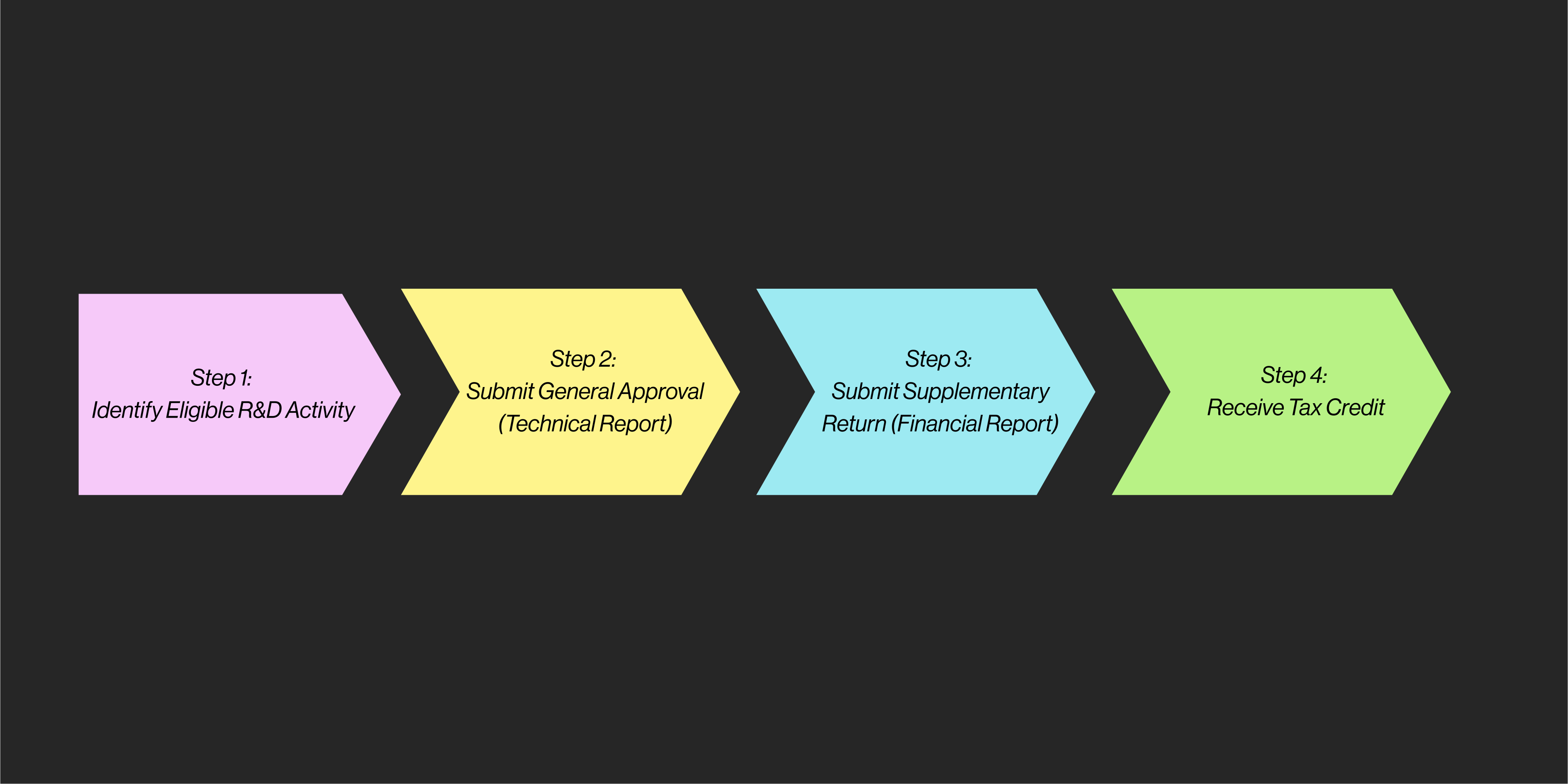
Step 1: Identify Eligible R&D Activities
The first step in the RDTI process is identifying the work within your business that meets the eligibility criteria.
The RDTI is a retrospective claim. This means you are claiming for R&D work that has already been carried out within a specific financial year. At this stage, you’re looking back at the projects your business has worked on during that period.
At a high level, eligible R&D activities need to involve resolving a technical or scientific uncertainty. In simple terms, you’re working on something where the answer isn’t already known and can’t be easily solved using existing knowledge.
At Swell, we simplify this into three key elements. For a project to be eligible, it should demonstrate:
- The objective — what you were trying to achieve
- The uncertainty — the technical challenge you faced
- The approach — the systematic process you took to solve it
In practice, this could include developing new products, improving existing ones, or innovating on processes such as automation, customisation, or integrating different systems.
A systematic approach is key. Testing ideas, prototyping, learning from results, and iterating over time are all strong indicators of eligible R&D.
For many Kiwi businesses, the scope of eligible R&D is often broader than their internal definition. In practice, that means you may be doing more eligible R&D than you think.
Step 2: Submit General Approval (Technical Application)
Once you’ve identified the R&D activities within your business, the next step is to get approval for these by submitting a General Approval application.
This is the technical part of the process and is submitted to MBIE. It focuses on explaining the R&D work you’ve carried out, rather than the costs.
For each project or activity, you’ll need to clearly describe what you were trying to achieve, the uncertainty you were facing, and the approach you took to resolve it. In other words, this is where you demonstrate how your work meets the eligibility criteria.
The goal is to present your work in a way that is clear, structured, and grounded in what you’ve actually been doing. For many businesses, the challenge here isn’t the work itself, but translating it into the right format.
Once submitted, MBIE may come back with questions or requests for further information before granting approval. This is a normal part of the process. You, or your advisor, will need to work through these queries to move the application forward.
Note: It’s important that you submit your General Approval before the application deadline. This is three months after your balance date. For example, if you have a 31 March balance date, your deadline is 30 June.
Step 3: Submit Supplementary Return (Financial Application)
Once your General Approval is approved, the next step is to submit your Supplementary Return.
This is the financial component of the claim. Here, you link your R&D expenditure to the approved R&D activities and calculate the total amount you’re claiming.
The Supplementary Return is submitted to IRD to support your RDTI claim and must be filed within 30 days after the due date of your income tax return. It can be submitted before your income tax return if required.
At this stage, you’ll need to identify and allocate the costs associated with your R&D activities. These can include:
- Employee salaries and wages
- Contractor costs
- Materials and consumables
- Depreciation on assets used in R&D
- Certain overseas costs
A key part of this process is applying a reasonable method to apportion these costs to your R&D activities. This needs to be robust and able to stand up to IRD scrutiny.
For many businesses, record keeping is a common concern, especially when claiming for the first time. It’s important to note that your systems don’t need to be perfect from day one. What matters is that you can reasonably support your claim with the information you have, and improve your processes over time.
Step 4: Receive the Tax Credit
Once your Supplementary Return has been reviewed and approved by IRD, the final step is receiving your R&D tax credit.
In many cases, this is paid out as cash. Timing can vary, but once processed, the credit is returned to your business and ready to be used.
This is where the value of the RDTI becomes tangible. That funding can be reinvested back into your business to support further innovation, whether that’s hiring new talent, investing in equipment, or continuing to develop your products and technology.
The RDTI is designed to support an ongoing cycle of innovation. As you reinvest and increase your R&D activity, you can continue to claim in future years. Over time, this can lead to larger claims and greater support as your business grows.
Applying for the RDTI: DIY vs Working with an Advisor
When it comes to applying for the RDTI, you can either manage the process yourself or work with an advisor.
Taking a DIY approach can work for some businesses, particularly if you have strong internal capability across both technical and financial areas. However, the process does require time and coordination. Preparing General Approval, responding to questions, and correctly allocating costs can quickly become resource-intensive alongside day-to-day operations.
Working with an advisor can help simplify the process. An experienced advisor will guide you through eligibility, structure your applications, and ensure your claim is well-supported. This reduces the internal burden on your team and gives you greater confidence in the outcome.
How Swell Supports the Process
Swell is a specialist R&D funding advisor, focused on helping Kiwi businesses unlock the full value of the RDTI.
Our team brings deep expertise in the RDTI, alongside a blend of technical and financial capability. We’re not generalist accountants. Our focus is solely on R&D funding, which means we understand both the detail and the intent behind the scheme.
We work closely with your team to build a clear understanding of your business and the work you’re doing. From there, we help identify and capture the full scope of your eligible R&D, often uncovering more than initially expected.
We then manage the process end-to-end. This includes preparing and submitting your applications, as well as handling communication with MBIE and IRD on your behalf.
The result is a smoother process, less internal burden, and confidence that your claim is accurate, well-supported, and complete.
If you’re doing innovative work and want to understand what you could be eligible for, it’s worth having a conversation. Get in touch with the Swell team for a no-obligation chat to explore the opportunity.